

Oil is available — but not for everyone: which countries will survive the fuel crisis thanks to reserves
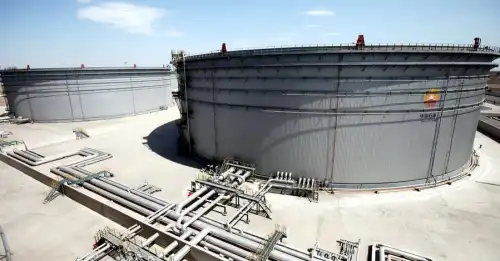
Photo: dpa/picture alliance
The war in the Persian Gulf continues to expose global problems with the thoroughness of a Cold War civil defense inspector. Gasoline, food, the internet — all under threat. But it turns out that fuel reserves exist, though not universally. Which countries have emergency stockpiles — read in the article Briefly about.
A strategic petroleum reserve is a state-controlled stock of crude oil that has already been extracted and stored, intended for use in the event of supply disruptions or market emergencies.
Amidst the chaos of the initial days of the war between the US, Israel, and Iran on March 11, 32 member countries of the International Energy Agency (IEA) agreed to release 400 million barrels of oil from their strategic reserves to drive down prices and prevent global panic.
This is double the amount the IEA released to the market in 2022 following Russia’s invasion of Ukraine: 182 million barrels.
Interestingly, the system was developed back in 1973–1974. At that time, Arab countries reduced exports by 25% in protest against US support for Israel during the Yom Kippur War. Global oil prices soared by 350%. If translated to today’s prices, this would be equivalent to $70 USD. And after the US and Israeli attack on Iran on February 28, 2026, the cost jumped to $245.
To prevent such cataclysms in the future, many countries began building reserves for the Judgment Day, Black Day, or any other bad day. Who turned out to be the wealthiest?
Information on the quantity of reserves in each country varies, and in many cases, this information is kept secret, which is understandable — that’s the purpose of a strategic reserve. Therefore, we used data from various reputable sources.
USA: 200 days of oil reserves
According to the U.S. Energy Information Administration, the United States maintains approximately 415.4 million barrels of crude oil in its Strategic Petroleum Reserve, Reuters reports. This oil is stored underground in a series of large salt domes at four locations along the Gulf Coast in Texas and Louisiana. In addition to this government reserve, about 439.3 million barrels of oil are held in commercial reserves by private companies.
According to calculations by the Reuters news agency, the special oil reserve currently covers approximately 200 days of net crude oil imports.
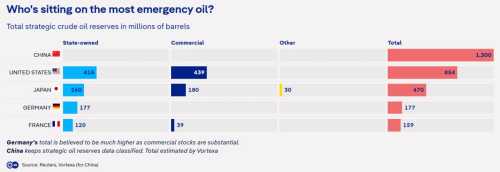

Leading countries in oil reserves for a ‘rainy day’. Photo: Reuters, Vortexa
Japan: 254 days without supply
According to the Japanese publication Nikkei Asia, by the end of 2025, the country had approximately 470 million barrels of oil in its emergency reserves, enough to cover 254 days of domestic consumption. Of this amount, 146 days of oil reserves are state-owned, 101 days are privately held, and the remainder is stored jointly with oil-producing countries.
Japan established its national oil reserve system in 1978 to prevent future economic shocks following the global oil crisis of 1973. The country remains one of the world’s largest oil importers, relying on foreign fossil fuels for about 80% of its energy needs.
China: Oil reserves are classified, but there are a lot of them
It is believed that China possesses the largest emergency reserves — at least 50% more than the United States. Although Beijing meticulously conceals the exact figures, the energy and shipping analytics firm Vortexa estimates the country’s total reserves at 1.3 billion barrels.
These strategically important oil reserves are located primarily along China’s eastern and southern coasts in provinces such as Shandong, Zhejiang, and Hainan.
According to Kpler data, in 2025, China purchased over 80% of the Iranian oil supplied to the country. Therefore, as the war in Iran escalates, Chinese companies like the Sinopec refining company have begun seeking permission to use oil from the country’s reserves, as reported by Reuters.
Europe: 3 months of security
EU countries are legally obliged to maintain reserves that would allow them to last for 3 months without energy supplies. This is being fulfilled. However, no one is building reserves for more than 90 days.
United Kingdom. According to the UK Department for Energy Security and Net Zero, as of February 26, 2026, the country held approximately 38 million barrels of crude oil and 30 million barrels of petroleum products as strategic reserves. These reserves are believed to be sufficient for about 90 days.
France. By the end of 2024, Paris had reserves of crude oil and petroleum products amounting to about 120 million barrels.
Spain. On March 16, Madrid approved the release of approximately 11.5 million barrels of oil reserves for 90 days to counter supply shortages caused by the de facto closure of the Strait of Hormuz, as reported by Minister of Energy Teresa Ribera. This is the country’s contribution to the IEA program. The total oil reserves in the country amount to about 150 million barrels.
Italy. According to legislation, in 2024, Rome held oil reserves of approximately 76 million barrels, corresponding to 90 days of average net oil imports to Italy.
Germany. The country stores about 110 million barrels of crude oil, as well as approximately 67 million barrels of finished petroleum products.
“Lucky” countries: they don’t need oil reserves
These are countries that produce enough oil and gas within their own territories.
For example, Canada does not have a strategic petroleum reserve and is not obligated to have one, as it is an oil exporter itself. The country ranks fourth globally in oil production and, in December 2025, produced over 5 million barrels per day, with the majority of exports directed to the United States.
Venezuela is doing well — it has enough oil reserves in the ground for 300 years! Russia also has sufficient reserves of its own, unfortunately. Norway is also not complaining about the situation.
Kazakhstan, Brazil, and Nigeria have enough oil for their needs. Nigeria also has sufficient gas resources.
And, of course, the Persian Gulf countries — Iran, Iraq, Saudi Arabia, Kuwait, Bahrain, Qatar, and the UAE — have enough of their own reserves. What they lack is peace. Just like all of us.